
by Nat Levy
It’s a sensitive subject, but engineering is all about failing until you succeed.
If you’ve ever had a job interview, you’ve probably heard this question: “Tell us about a time you failed.” Admitting failure is a hard thing to do.
This is true in every discipline, including engineering. However, it’s important to remember that engineering is all about trying new things. Sometimes, that means failing.
A few of our courageous engineers told tails of fails big and small, and the lessons they learned from those challenges.
Here they are, in their own words.
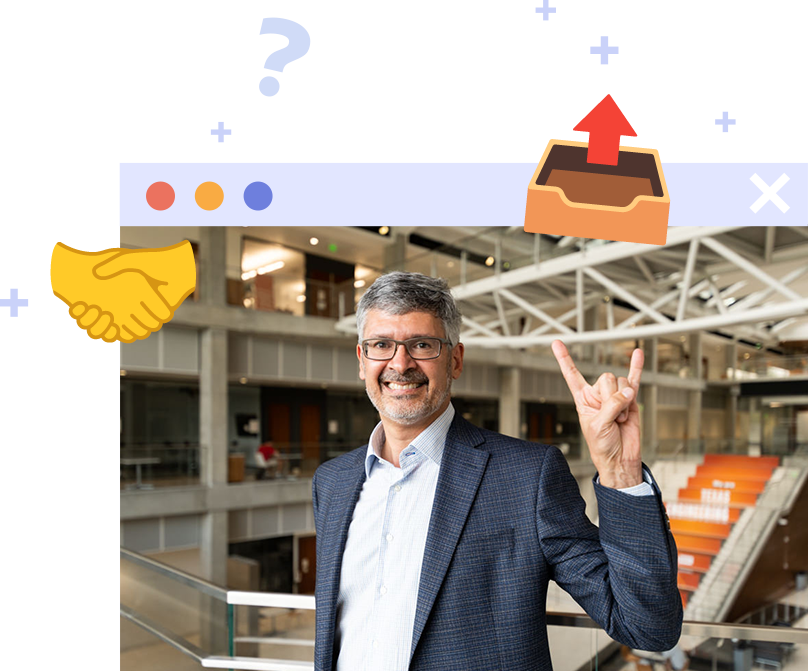
Roger Bonnecaze
dean, Cockrell School of Engineering
Roger Bonnecaze
Dean, Cockrell School of Engineering
Many years ago, I submitted a paper to a journal that was rejected. No big deal, this happens all the time. That’s not the failure here. I actually sent it to a better journal that accepted it. It went on to become one of my most highly cited papers.
About a month later, the journal that rejected my paper reached out to me to review another paper. I forwarded the request to my collaborators as a joke, as in, “Can you believe these guys?”
But I accidentally CC’d the editor’s assistant from the journal as well. I figured it out about 10 or 15 minutes later.
I was mortified. But I didn’t let it fester; I immediately wrote back to her and apologized.
"I'm a strong believer in the idea that if you screw up, you try to clean up the mess as quickly as possible, rather than pretending it didn’t happen."
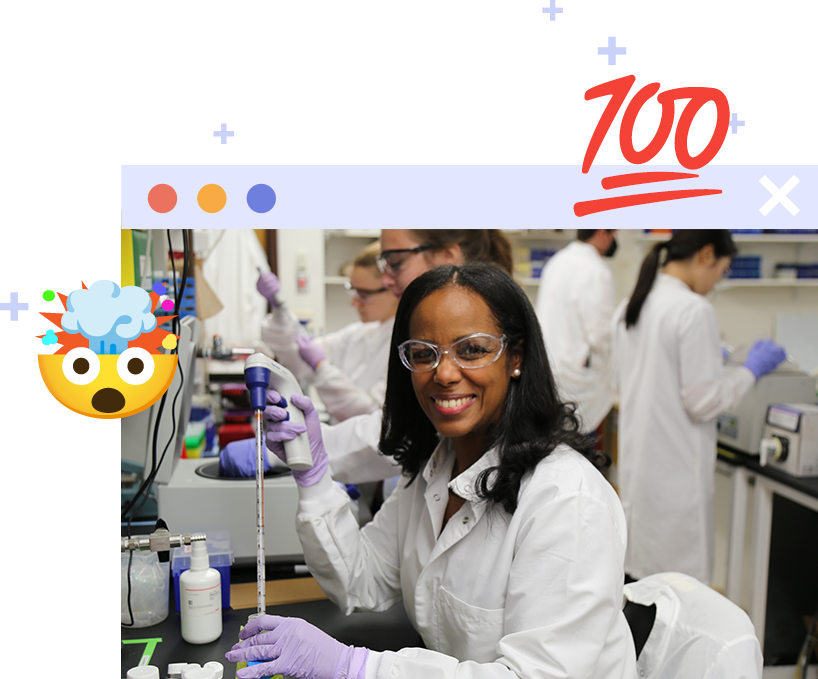
Lydia Contreras
professor, McKetta Department of Chemical Engineering
Lydia Contreras
Professor, McKetta Department of Chemical Engineering
I faced one of the most humbling experiences of my academic life during my first year of college: failing my first physics exam. Coming from a top high school where I had excelled in challenging courses, including AP Physics, I thought I was fully prepared for college. My confidence was reinforced by years of success and the assumption that hard work (even in the absence of any strategy) always translated into top grades and that it guaranteed success.
But, stepping into an elite university’s large lecture halls, navigating intimidating recitations and adjusting to life away from home was overwhelming. In the midst of this, I was crushed when my first exam came back with a failing grade.
I couldn’t sleep, lost my appetite, and felt the weight of disappointing not just myself, but my family and community, who supported me so strongly. For the first time, I questioned whether I belonged in college or in engineering at all. I felt like my world and all my dreams were collapsing.
Ironically, that failure became one of my greatest teachers and represented the beginning of my growth as a college student. It forced me to confront the reality that college learning required new strategies.
I learned that success in STEM education wasn’t about just rereading the textbook. Instead, it was about actively practicing problems and applying concepts in different ways. This shift in approach took effort, but it transformed how I learned and ultimately helped me succeed.
"Failing that exam taught me that failures are not 'the end'; instead, they are essential stepping stones in our growth."
As an experimentalist in science, I’ve developed a “failure reset” protocol that I still use:
- Allow myself to feel the pain of failure and cry to “cleanse.”
- Do something that I love to do to bring out the best of me and reenergize.
- Reflect on things that I could do better and reach out to my support community to brainstorm new solutions.
- Try again!
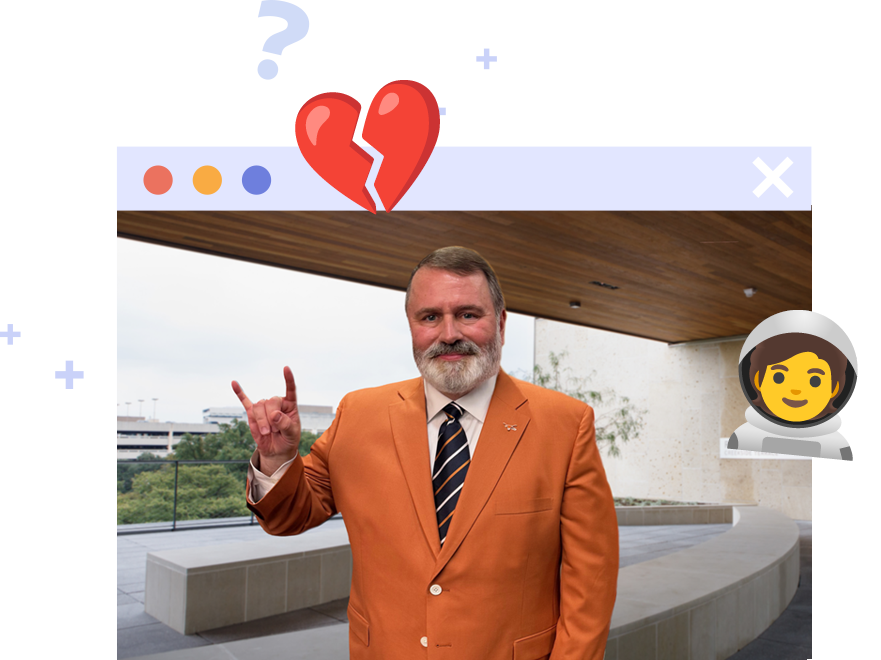
Dan Deans
B.S. Aerospace Engineering 1990, president and COO MORI Associates
Dan Deans
B.S. Aerospace Engineering 1990, President and COO, MORI Associates
During my (second) senior year, my aerospace buddy—and future brother-in-law—Jim and I decided we wanted to become fighter pilots in the Air Force. Flying fighter jets had always been a dream of mine.
We reached out to Hans Mark, who was a former secretary of the Air Force and chancellor of the UT system at the time. He also taught our Aerospace Engineering 201 class. He agreed to speak to us, and I remember this interview well.
He grilled us for hours on everything from our less-than-stellar GPAs to why we wanted to be fighter pilots. It was a wonderful conversation, and to our delight, he agreed to write letters of recommendation for both of us for Air Force Officer Training.
About three months later, we heard back, and we were both rejected. I was dumbfounded and really disappointed.
But I went on to graduate, and through many fortuitous circumstances, I did get a job after graduation with Ford Aerospace as a contractor at NASA’s Johnson Space Center and then met my future wife, got married, and had four beautiful kids.
I’ve been fortunate to have had an incredible 35-year career spanning four different industries: aerospace, chemicals, semiconductors and information technology.
I learned that following my heart was not always what was best for me. This time, what was best for me was to trust that there was something even better waiting just over the horizon.
"And it all happened because I failed to get into the Air Force."
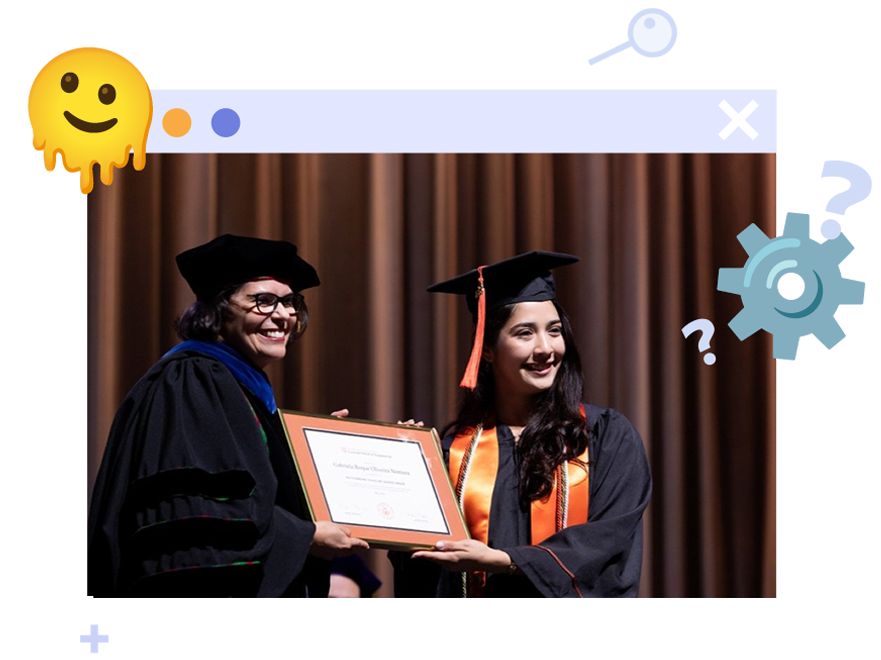
Gabriela Nomura
2025 Outstanding Scholar Leader, Department of Biomedical Engineering
Gabriela Nomura
2025 Outstanding Scholar Leader, Department of Biomedical Engineering
In one of my classes, I was part of a group project to build a medical device for any medical condition of our choice. We chose to build a prototype that used machine learning to predict whether a photo of a blemish on a user’s skin was malignant or not. I was tasked with creating the machine learning model, which was not a challenge since I was used to doing that in my research job.
I was then assigned to solder all the components of the device, something I hadn’t done much of before. I tried, but I was unsuccessful. Every time I tried to solder two metal pieces together, I burned my fingers.
It was frustrating. How could I, a biomedical engineer, not know how to do such a small task properly?
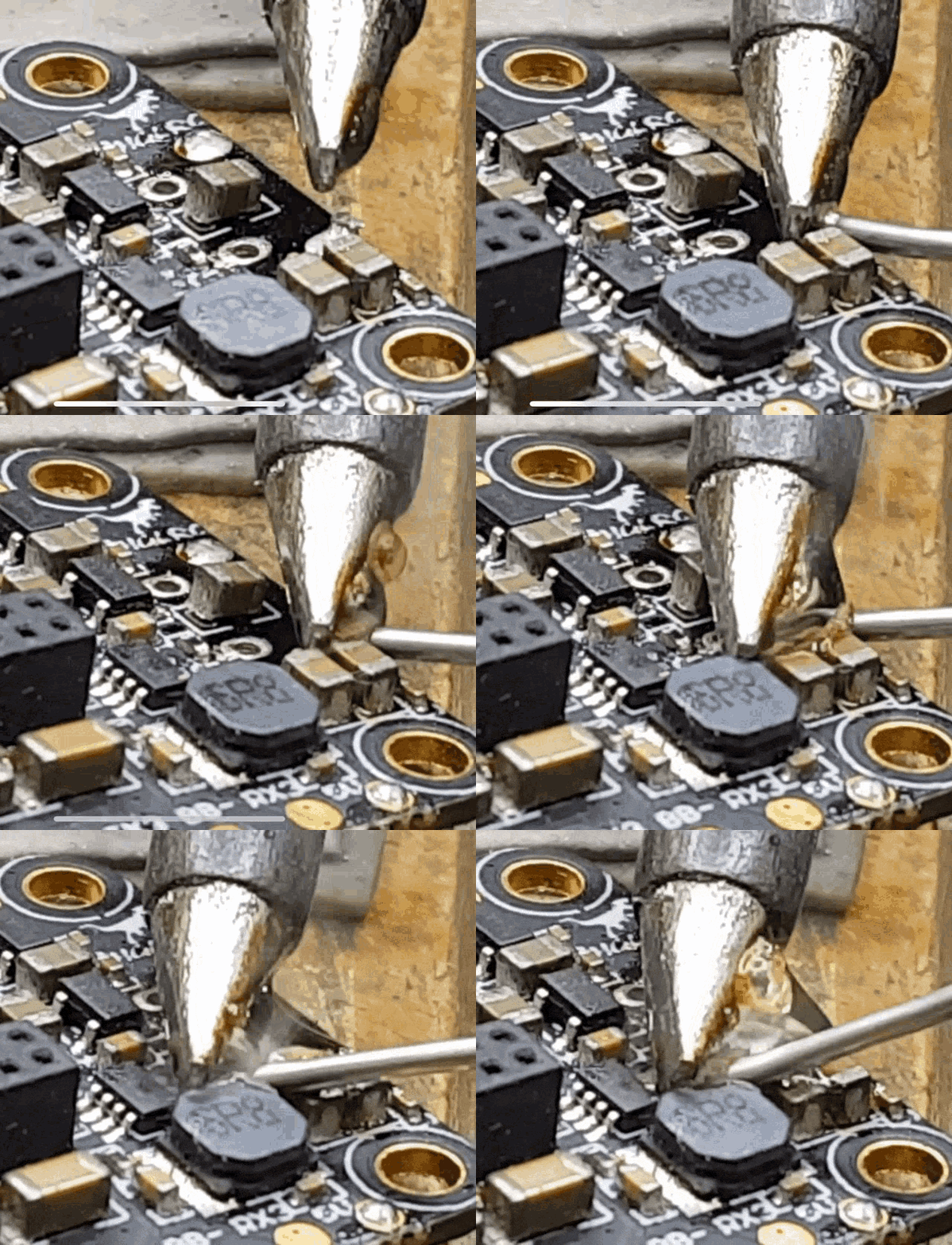
Although I was a little embarrassed, I asked a teammate for help soldering. Thanks to him, and his patience teaching me, I was able to carry out my final task in that project. As the first medical device that I ever built, it was a very special memory to me. And I still carry the lesson from this project with me.
If something seems impossible, don’t be afraid to ask for help. I continue to need help soldering sometimes, but at least I have improved over the years!
"If something seems impossible, don’t be afraid to ask for help. I continue to need help soldering sometimes, but at least I have improved over the years!"
Jayesh Parekh
M.S. 1980 Electrical Engineering, Managing Partner, Good Protein Fund
Jayesh Parekh
M.S. 1980 Electrical Engineering, Managing Partner, Good Protein Fund
We had a startup called Mobi Apps that encountered funding problems during the 2007-2008 recession. Because of that, we unfortunately had to sell the company.
We were able to make sure all the 69 employees went to work for the new company. The product continued to be sold, but the investors all lost money.
That was a huge learning experience for me. From that point on, I realized that you have to always be ready to handle bumps, like the ones in 2000, 2007 and 2020.
"Unfortunately, you can't see these things coming, but with resilience, you can overcome them."
FAIL IT FORWARD
Want to share your fail tale with us and our students? Share your story here.
 |
|